ShibTorch: burn tokens on Shibarium
Cryptocurrencies can be "burned" through a process where tokens are intentionally removed from circulation, typically by sending them to a public address that can only receive tokens but cannot spend them. This address is often referred to as a "burn address".
In fact, the use of burn addresses is the most common method to eliminate tokens from circulation. This address is designed to be unspendable, meaning the tokens sent to it are effectively taken out of circulation permanently.
Why Cryptocurrencies are Burned
There are a few reasons why burning crypto is important:
-
Inflation Control: For cryptocurrencies with inflationary supply models (where new tokens are continuously created), burning can act as a deflationary mechanism to balance or reduce the inflation rate.
-
Reducing Supply: By reducing the total supply of tokens, the remaining tokens can potentially increase in value due to the principles of supply and demand. This can be beneficial for holders of the cryptocurrency.
-
Incentivizing Holding: Burning tokens can incentivize holders to keep their tokens rather than sell them, with the expectation that the token's value will increase over time.
EIP-1559: Base and Priority Fees
EIP-1559, which stands for Ethereum Improvement Proposal 1559, is a significant upgrade to the Ethereum network's fee mechanism. It was implemented as part of the London hard fork on August 5, 2021. The primary goals of EIP-1559 are to improve the user experience with transaction fees, make the fee market more predictable, and reduce the volatility of gas fees.
EIP-1559 introduced a new concept called the base fee, which is the minimum amount of gas that must be paid for a transaction to be included in a block.
The base fee is automatically adjusted by the protocol based on network congestion. When the network is busy, the base fee increases, and when it is less congested, the base fee decreases. This makes the fee system more predictable and helps users estimate the cost of their transactions more accurately.
By making transaction fees more predictable, EIP-1559 helps users avoid overpaying for transactions and reduces the frustration associated with fee estimation.
The base fee is burned, effectively removing a portion of the transaction fees from circulation. This introduces a deflationary aspect to Ethereum, as a portion of ETH is permanently destroyed. The burning of the base fee aims to reduce the total supply of ETH over time, which could potentially increase its value.
In addition to the base fee, users can include an optional priority fee, also known as a tip, to incentivize miners to prioritize their transactions. The priority fee is paid directly to the miners and can help expedite the inclusion of a transaction in a block during times of high network demand.
ShibTorch Burn Process
Shibarium's Burn Hardfork implements the EIP-1559 features and enables our own burning mechanism: ShibTorch. It works as an interactive dashboard where the Shiba Inu community can actively participate in and monitor the process of burning SHIB tokens.
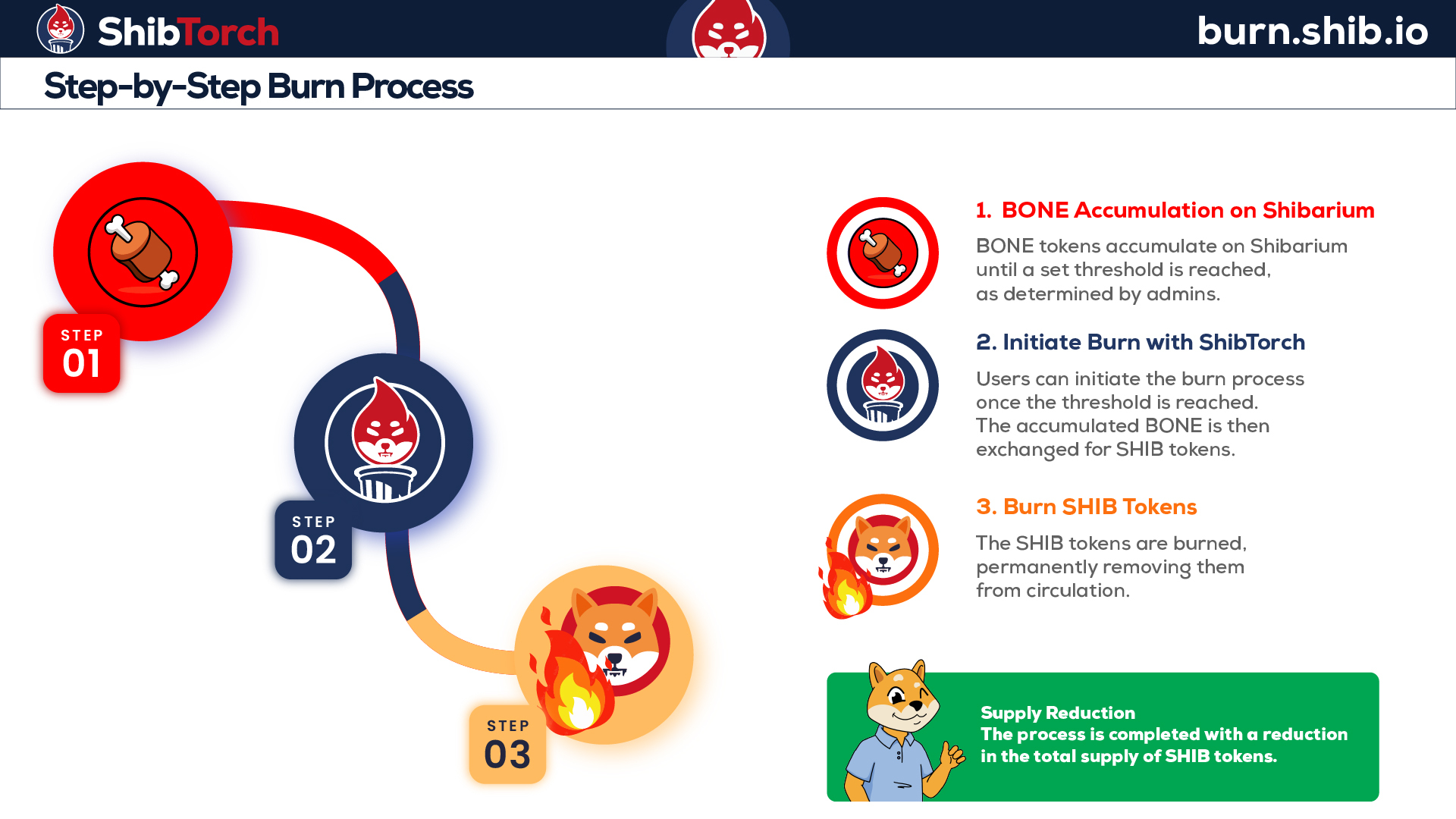
Each time a user pays for any Shibarium L2 transaction, the base fee is locked in the burn contract on Shibarium, while the priority fee is directed to the validator. As BONE accumulates from transactions in the burn contract, any user can initiate the burn process from Shibarium.
The burn process begins on Shibarium and is finalized on Ethereum. When a predetermined amount of BONE is accumulated (the threshold can vary and is set by admins), users can initiate the burn process using ShibTorch. The accumulated BONE is then transferred to Ethereum's L1, where it is exchanged for SHIB tokens. These SHIB tokens are subsequently burned, and thus permanently removed from circulation, leading to a reduction in the total supply of SHIB.
ShibTorch is an example of a Shiba Inu’s continued commitment to delivering decentralized solutions and puts community first by allowing anyone to initiate burns once the required amount of BONE is accumulated. This decentralized approach ensures scalability without bottlenecks.
Check the full ShibBurn smart contract on either Shibariumscan or Etherscan.
ShibTorch Technical Details
As of 2025, ShibTorch has been updated to improve users experience by adding extra security, streamlining the Burn process among other technical changes. Here is the current state of ShibTorch:
Internal Features
- UUPS Upgradeable Pattern: The Ethereum and Shibarium Burn contracts are now using the UUPS (Universal Upgradeable Proxy Standard) pattern. This is a more gas-efficient way to handle upgradability compared to the older proxy patterns. It allows emergency updates while maintaining security and reducing overhead.
- POS Bridge: The Burn service uses the POS (Proof-of-Stake) bridge, which simplifies the process to two steps, making asset transfers faster and more user-friendly.
- Advanced Swap Routing with ShibaSwap v1/v2: The swap service can now dynamically find the best trade paths between ShibaSwap v1 and v2, selecting the best values for the SHIB and BONE pair during the Burn process.
- Slippage Protection and Price Optimization: This ensures that when tokens are swapped for burning, the transaction is executed at a price close to what was expected. It prevents excessive losses due to market volatility or poor liquidity conditions, improving efficiency in the burn process.
Technical updates
- Migration to Solidity 0.8.24: This ensures compatibility with the latest compiler optimizations and security improvements, such as built-in overflow and underflow protection, reducing the need for extra checks in the code.
- Improved Event Logging System: This means more detailed and structured event emissions, making it easier to track contract activity off-chain. Improved logging is particularly useful for analytics, debugging, and compliance, ensuring that every important action is transparently recorded.
- Added Comprehensive Access Controls: This implements a more refined role-based access control (RBAC) system, preventing unauthorized contract interactions.
- New Price Quotation System for Optimal Routing: This improves the efficiency of swaps by fetching and executing the best possible price for transactions.
Security Improvements
- ReentrancyGuard for critical functions: This prevents reentrancy attacks, a common exploit in smart contracts where an attacker repeatedly calls a function before previous executions are completed.
- Enhanced error handling with custom errors: This builds on the previous update by improving error messages while reducing gas costs.
- Emergency Controls & Pausable Functionality: This adds a security layer, allowing for the pause of the burn function in case of an exploit, bug, or network instability. It’s a standard security feature in well-designed DeFi protocols.
Tutorial: how to Burn Tokens on Shibarium
- Head to ShibTorch website and connect your wallet. The amount of accumulated BONE from base fees will be displayed on the page. As we stated before, BONE tokens will be converted into SHIB, that's why the Total Amount Accumulated shows the correspondent value of SHIB based on the BONE accumulated in the contract.
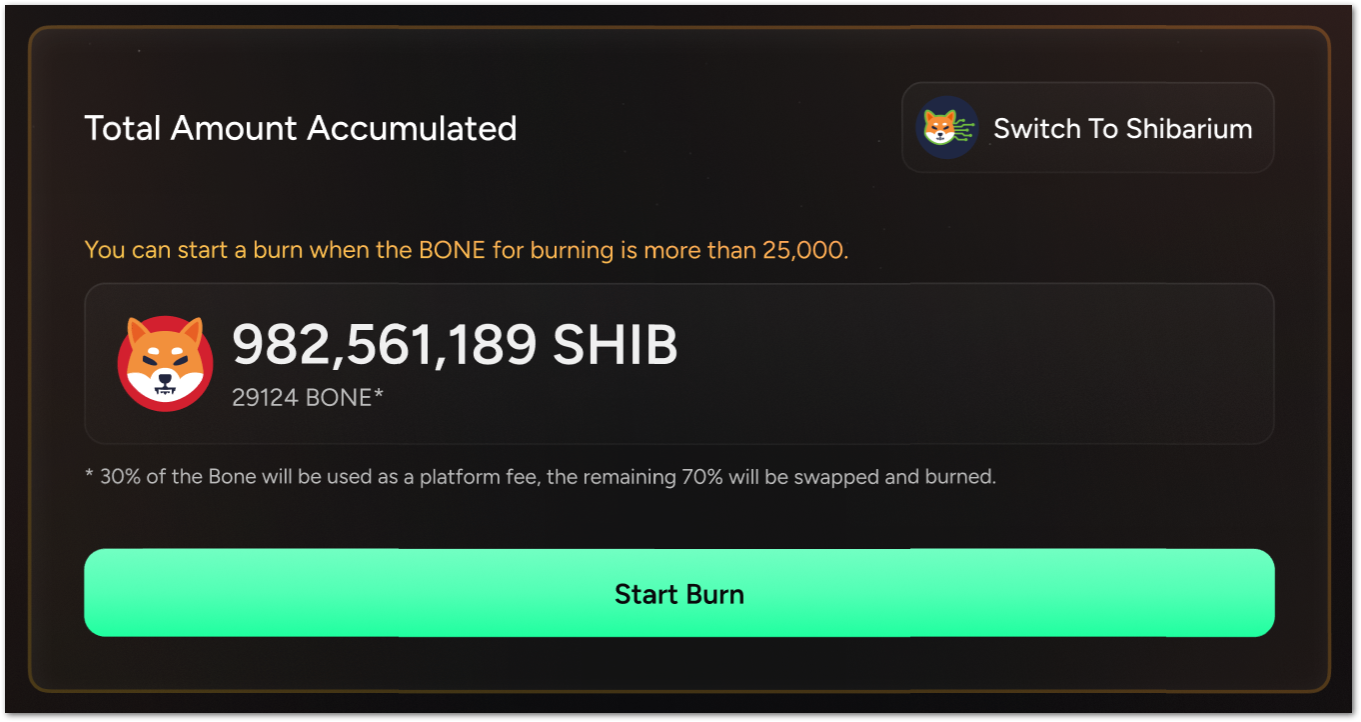
- You can then click on Start Burn. This triggers the swap between BONE and SHIB, where 30% of the BONE goes to the treasury wallet and the remaining 70% is used for the SHIB conversion. In the same transaction, the SHIB amount is withdrawn to the Ethereum network. Confirm the transaction on your wallet application.
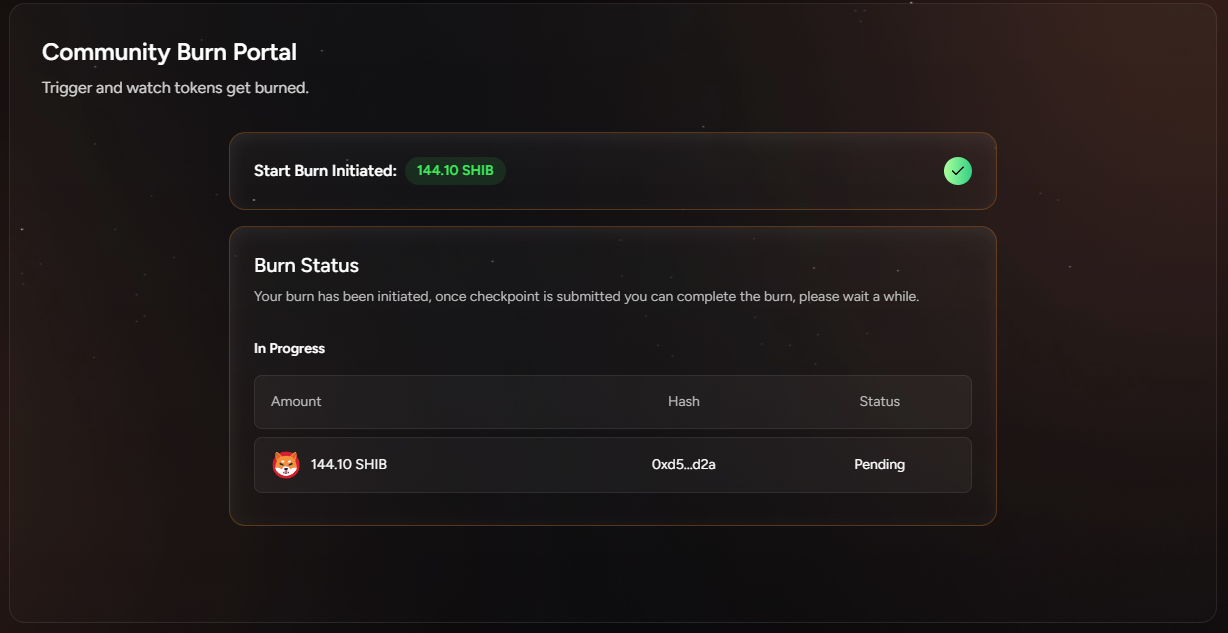
- The transaction is then moved to the Token Burn Tracker. Once the checkpoint is submitted to Ethereum, the button Complete Burn is enabled. After clicking on it, a wallet prompt should appear to continue the process. This is when the Burn process is completed, as the SHIB tokens are burned in Ethereum, i.e. they are transfered to a dead wallet
0x000000000000000000000000000000000000dEaD.